

Plan the perfect Amalfi Coast trip with honest advice on towns, hotels, ferries, buses, beaches, food, budgets, itineraries, and 2026 driving rules.
The first thing the Amalfi Coast teaches you is that distance is a liar. Amalfi and Positano look almost close enough to exchange gossip across the water. On a map, the road between them is a modest squiggle. Then a bus meets another bus on a bend designed when the widest vehicle was probably a nervous donkey, both drivers begin an operatic negotiation involving horns, mirrors, and millimeters, and your twenty-minute estimate develops a rich inner life.
My most useful lesson arrived outside Amalfi, where I stood holding a lemon granita while the bus I intended to catch filled before my eyes and left without me. There was no cinematic tragedy. A local woman shrugged, pointed toward the ferry pier, and returned to discussing tomatoes with her friend. The granita was sharp enough to pinch the back of my jaw, the next boat came, and the day improved immediately. That small failure contains the entire coast: plans matter, flexibility matters more, and lemons can rescue nearly anything.
This complete Amalfi Coast travel guide will help you choose a base, arrive from Naples or Salerno, master buses and ferries, plan a realistic budget, find worthwhile beaches, hike the Path of the Gods, and build an itinerary that does not treat eleven towns like a supermarket sweep.
The coast is not cheap, flat, quiet, or forgiving of bad planning. It is also more than expensive terraces and staged linen outfits. Behind the storefronts are paper makers, fishermen, lemon groves, family bakeries, and residents trying to reach work while visitors block a staircase. Bring patience.
The Amalfi Coast in One Honest Minute
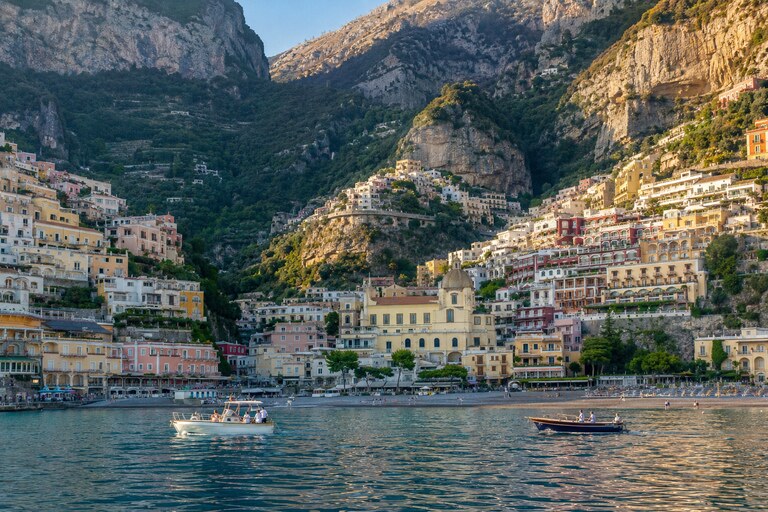
The Amalfi Coast, or Costiera Amalfitana, follows the southern Sorrentine Peninsula in Campania. Its UNESCO-listed landscape covers fifteen municipalities and 11,231 hectares. UNESCO stresses what Instagram crops out: generations engineered terraces for lemons, grapes, and olives, linking settlements with stairs and mule tracks.
Amalfi is the historic transport hub. Positano is the vertical fashion plate. Ravello brings gardens and music; Praiano, calmer sunsets. Maiori works for families, Minori for pastry, Cetara for fishing culture, and little Atrani for lived-in lanes. Vietri sul Mare makes ceramics that test luggage allowances.
My Tip: Do not confuse the Amalfi Coast with Sorrento. Sorrento is a useful gateway on the northern side of the peninsula, but it is not geographically part of the UNESCO coast. It can still be the right base if you prioritize Pompeii, Capri, and easier rail access over waking beside Amalfi or Positano.
Quick planning facts
- Best trip length: Five nights for a satisfying first visit; seven nights if you want beach time, hiking, and smaller villages.
- Best months: May, early June, late September, and early October.
- Main airports: Naples International Airport (NAP) and Salerno Costa d’Amalfi Airport (QSR).
- Best car-free bases: Amalfi, Maiori, Minori, and Salerno.
- Currency: The euro (€).
- Emergency number: 112.
- Language: Italian; English is common in tourism businesses, less universal away from visitor centers.
- Physical reality: Expect stairs, steep lanes, uneven stone, strong sun, and luggage logistics worthy of military planning.
When to Visit Without Melting or Queueing for Your Own Shadow
Spring: terraces wake up
From April through May, walking temperatures are usually comfortable and ferry service expands. April brings changeable seas and holiday crowds. May is my favorite compromise: long daylight, outdoor lunches, and humane hiking weather.
Summer: beautiful, expensive, crowded
June through August brings hot beach weather, frequent ferries, packed buses, peak hotel rates, and traffic. In July and August, sightsee early, reserve dinner, and accept that midday Positano resembles a fashion convention on a staircase.
If summer is your only option, stay overnight. Before 10:00 a.m. and near dinner, the famous towns become more breathable.
Fall: warm water, softer edges
September often keeps summer warmth while families return to school. It remains busy, and 2026 driving controls apply daily throughout the month. Early October can be excellent, though ferries thin out and storms become more likely. Build slack into airport-day connections.
Winter: real life, limited logistics
From November through March, prices fall, but many hotels, restaurants, tours, and ferries pause. Buses continue; daylight shrinks and rain affects trails. Winter suits repeat visitors content with coffee and quiet, not first trips built around boats and swimming.
My Tip: Check live ferry and trail conditions every morning. A forecast for Naples does not describe a mountain path above Agerola, and a calm breakfast does not guarantee an afternoon sailing.
How Many Days Do You Actually Need?
A rushed Amalfi Coast day trip often becomes three queues connected by a bus. Two nights cover one main town and a neighbor; three work for Amalfi, Ravello, and Positano. Five feel satisfying. Seven absorb bad weather.
For a first visit, choose five nights in one base. Hotel hopping stops looking clever halfway up ninety steps. With a week, split Positano or Praiano and Amalfi, Minori, or Maiori.
Where to Stay on the Amalfi Coast
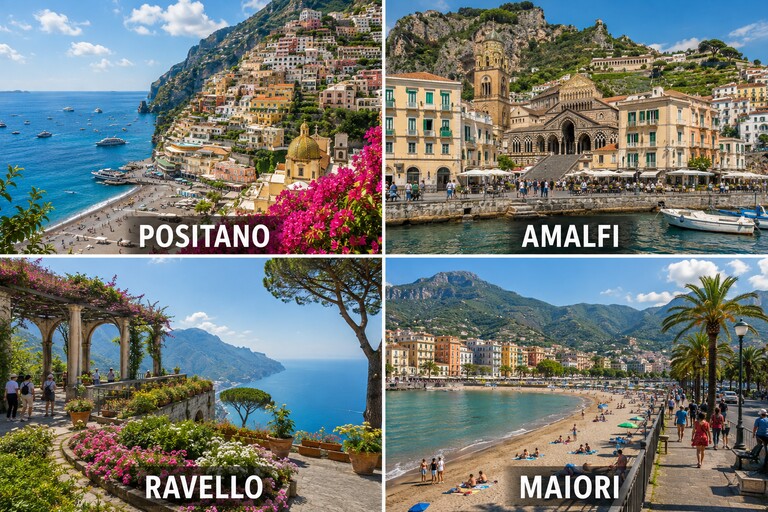
Your base controls budget and daily friction. Check the map, recent reviews, stair access, and exactly how luggage reaches reception. “Five minutes from the center” may mean vertically—different mathematics.
Positano: for first-time drama and a generous budget
Choose Positano when waking inside the coast’s recognizable town matters more than value. You gain quiet early hours, seasonal ferries, restaurants, and beaches—but steep stairs and premium rates.
Lower rooms reduce climbing but cost more; higher rooms offer broader views and stronger calves. Positano earns its honeymoon price when a private terrace and porter service are included.
Amalfi: the smartest all-round base
Amalfi is my first-timer pick. Ferries and buses converge here, Ravello is accessible, Atrani is walkable, and restaurants span more budgets than in Positano.
Stay near Piazza Duomo or the waterfront for transport; Valle dei Mulini is quieter. For car-free exploration, this is the simplest answer.
Praiano: for couples, sunsets, and relative calm
Praiano lies between Positano and Amalfi, with fine sunsets and slower nights. It suits couples and repeat visitors, but hotels can sit far above the water and beaches demand stairs.
Ravello: for romance above the road
Choose Ravello for gardens, concerts, refined hotels, and quieter evenings. With no ferry port, every coastal outing starts with a descent and ends uphill. Excellent for two peaceful nights; awkward for beach hopping.
Maiori and Minori: for families and better value
Maiori has a broad waterfront and family-friendly beach. Minori is smaller, food-focused, and linked to Ravello by the stair-heavy Path of Lemons. Both usually beat Positano on value.
Salerno: for budget travelers and transport simplicity
Salerno has trains, normal-city prices, and seasonal ferries. Stay near Salerno Centrale or the port. You trade fantasy-at-breakfast views for painless arrivals and a kinder hotel bill.
Booking strategy: Reserve refundable accommodation early for May through October. Filter for air-conditioning, step-free access, porter service, and proximity to transport. “Sea view” does not mean private balcony.
CHECK AMALFI COAST HOTELS ON BOOKING.COM
Getting to the Amalfi Coast
There is no train line running through Positano, Praiano, or Amalfi. Your final approach will be by road or sea.
From Naples Airport
From Naples International Airport, the official €5 Alibus runs to Napoli Centrale and the port. For the eastern coast, take a fast train to Salerno, then a seasonal ferry to Amalfi or Positano. From the west, travel to Sorrento, then continue by ferry or SITA Sud bus.
The seasonal Campania Express offered reserved seating between Naples, Pompeii, and Sorrento, but EAV suspended it from October 1, 2026, until further notice. Regular Circumvesuviana commuter trains continue. Check EAV before planning.
From Salerno Airport
Salerno Costa d’Amalfi Airport is convenient when its flight network matches your route. The official Salerno Airlink connects the terminal with central Salerno in roughly 30–40 minutes; the currently published fare is €8. From Salerno, continue by seasonal ferry or year-round bus.
When a private transfer earns its keep
A private car makes sense after long flights, for families, groups, reduced mobility, late arrivals, or remote hotels. You buy a direct journey and remove three failure points: late flight, missed train, full bus.
My Tip: Schedule a transfer for departure day if your flight is early. Do not trust a tight bus-to-train-to-airport chain on the SS163. The road has never cared about your boarding time.
Getting Around: Ferry, Bus, Car, or Mild Panic?
Ferries: usually the best coastal transport
From spring into fall, ferries link Salerno, Cetara, Maiori, Minori, Amalfi, and Positano, with selected services to Sorrento, Capri, and Naples. They avoid traffic and reveal the coast better than a windshield.
Check Travelmar’s official timetable and fares near departure. Short coastal legs often cost €5–€15 one way; longer routes cost more. Weather disrupts boats, so arrive 20–30 minutes early and check pier and luggage details.
SITA Sud buses: cheap, useful, and sometimes full
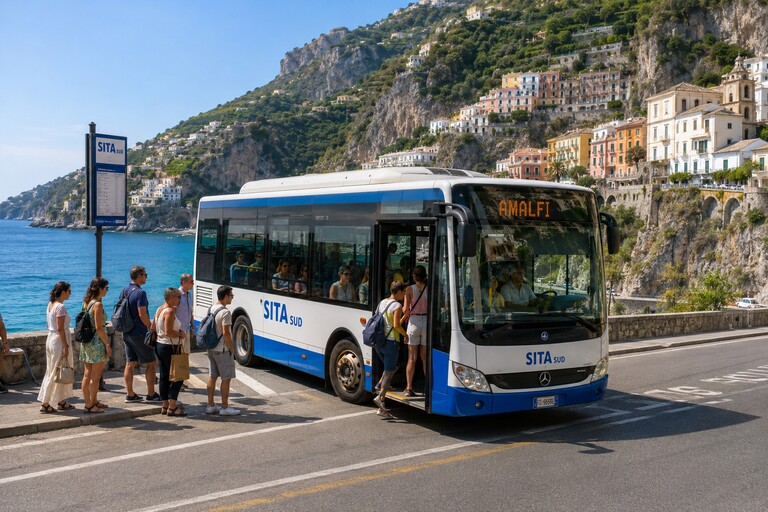
SITA Sud buses operate year-round on Sorrento–Positano–Amalfi, Amalfi–Ravello, and Amalfi–Maiori–Salerno routes. Download the current seasonal timetable.
Buy and validate tickets before boarding. Tobacco shops, newsstands, bars, and ticket offices sell them. Many journeys cost €2–€5. The COSTIERASITA 24-hour ticket is listed at €10, or €12 with certain local Positano buses. Confirm when buying.
Buses may pass full, especially at Positano in late afternoon. Never use the last theoretical connection for a flight or prepaid tour.
Driving: possible is not the same as pleasant
The SS163 Amalfitana is narrow and busy; stopping is often impossible. Central Positano parking carries painful hourly rates. Add scooters, buses, vans, blind bends, and a passenger offering useless advice.
In 2026, seasonal alternate-plate controls apply between Vietri sul Mare and Positano, generally 10:00 a.m.–6:00 p.m. On restricted dates, a plate matching the date’s parity cannot circulate: even endings are barred on even dates, odd endings on odd dates. Controls cover specified spring holidays, summer weekends, every day in August and September, and October weekends. Hotel guests have limited check-in and checkout exceptions; other exemptions vary.
Read the Amalfi Coast Tourism District traffic notice before renting; rental cars are not automatically exempt. Rent only for a wider road trip, choose a small vehicle, reserve parking, photograph damage, and hide luggage.
The Best Things to Do on the Amalfi Coast
Meet Positano before breakfast
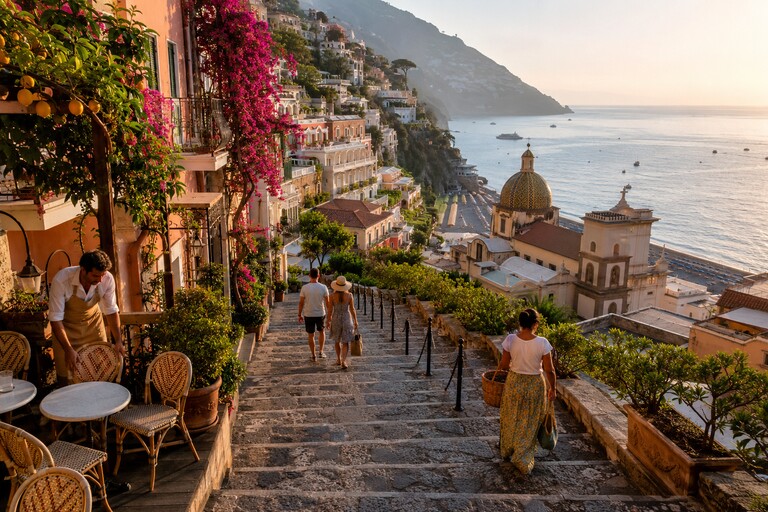
Positano works best early. Walk down Via Cristoforo Colombo, pause above the tiled dome of Santa Maria Assunta, then descend toward Spiaggia Grande while delivery carts rattle over stone and shopkeepers lift shutters. The beach is pebbly, the public section is limited, and the view back toward stacked houses is the main event.
Wander to Fornillo Beach via the coastal path for a slightly less theatrical scene. Return uphill slowly. The town charges interest on every staircase.
Give Amalfi more than an hour
Many visitors photograph Amalfi Cathedral, buy gelato, and leave. Stay. Enter the Monumental Complex, including the Cloister of Paradise, museum, crypt, and cathedral. It connects Saint Andrew with Amalfi’s maritime-republic history. Admission has recently been around €4; confirm locally.
Walk beyond Piazza Duomo into Valle dei Mulini, where lanes narrow and souvenir noise fades. Visit the Paper Museum for the handmade-paper tradition.
Spend a slow half-day in Ravello
Ravello is the coast’s pause button. Villa Rufolo combines Moorish-influenced architecture, gardens, and sea terraces; the 2026 adult ticket is €8. Villa Cimbrone Gardens costs €10 and ends at the Terrace of Infinity, where marble busts possess the calm of people who never catch buses.
If the Ravello Festival is running, check its official program. Music above water can still feel intimate.
Hike the Path of the Gods, but respect the name
The Path of the Gods, or Sentiero degli Dei, runs from Bomerano in Agerola toward Nocelle above Positano. Its 6.5–7-kilometer core takes roughly 2.5–4 hours; continuing to Positano adds many steps.
Walk Bomerano to Nocelle for the gentler direction. Start early, wear proper shoes, and carry 1.5 liters of water in warmth. Avoid storms, extreme heat, and closures. Exposed edges are real; never walk backward for video.
Cross from Amalfi to Atrani on foot
Atrani sits beside Amalfi, separated more by rock and road engineering than distance. Walk through the pedestrian tunnel route rather than along dangerous traffic lanes, then emerge into Piazza Umberto I. The square holds café chairs, laundry, children, and residents conducting daily life. Buy something, sit down, and do not treat doorways as props.
See the coast from a small boat
A small-group cruise gives you time to notice watchtowers, caves, terraces, and roadless beaches. Ask about passenger numbers, fuel and port fees, rough-weather policy, and the real itinerary.
Private charters suit groups and proposals; shared cruises cost less. Morning water is often calmer.
COMPARE AMALFI COAST BOAT TOURS ON GETYOURGUIDE
Visit Furore without expecting a town square
The famous Fiordo di Furore is a narrow inlet beneath an arched bridge. It is not a Nordic fjord, and Furore itself is scattered across the hillside rather than arranged around one center. Roadside stopping near the bridge is unsafe and frequently restricted. Arrive by authorized transport, boat, or a carefully planned bus journey, and obey closure signs for the beach and access steps.
Follow lemon country between Minori and Maiori
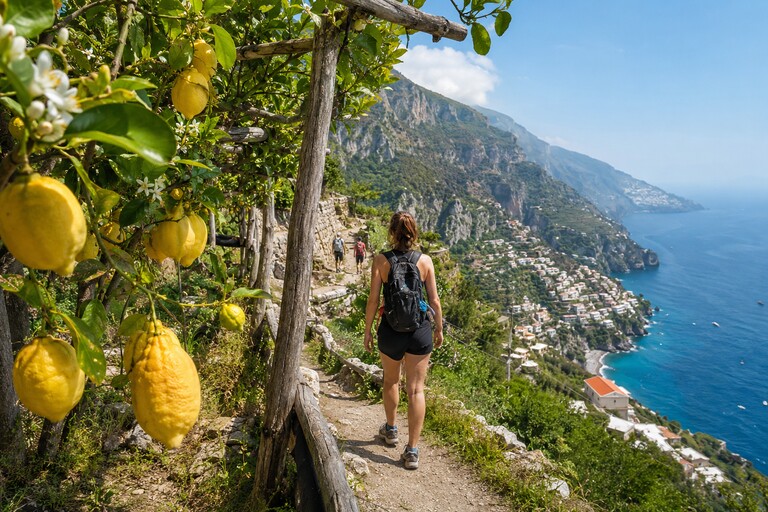
The Path of Lemons, or Sentiero dei Limoni, climbs through terraces between Minori and Maiori. It is shorter than the Path of the Gods but includes many stairs. You pass garden walls, irrigation channels, chapels, and groves trained beneath wooden supports. In season, the air carries citrus peel, damp earth, and the occasional motor of a tiny agricultural monorail.
Walk in the cooler morning, carry water, and buy directly from a producer when invited. A real lemon weighs more than the decorative impostors most supermarkets sell.
Eat anchovies in Cetara
Cetara remains closely associated with anchovy fishing and colatura di alici, a clear amber seasoning produced from salted anchovies. A few drops add deep marine salinity to pasta. Order spaghetti con colatura, grilled fish, or fried anchovies whose edges crackle while the flesh stays soft.
Visit the harbor, look back toward the town, and notice how fishing equipment occupies space that other villages give to resort furniture. This is a working identity, not a theme.
Take one ambitious day trip, not three
Capri offers walking, Roman history, and polished shopping. Pompeii needs at least half a day. Naples deserves several. Pick one.
For Pompeii, use the official archaeological park or a guide who turns roofless walls into homes, bakeries, and baths. For Capri, take an early ferry and walk beyond Marina Grande.
Beaches: Pebbles, Paid Loungers, and the Public Strip
The coast is not a ribbon of soft sand. Many beaches are small, pebbly, and divided between private lidos and public sections. Water shoes make entries easier. Beach-club prices vary sharply by town, row, month, and package; budget roughly €25–€80+ for a setup or per-person package in popular locations, with Positano capable of climbing higher.
Spiaggia Grande in Positano provides the famous town view but heavy traffic. Fornillo is a more relaxed walk away. Marina di Praia sits beneath cliffs near Praiano and loses direct sun earlier. Maiori Beach is long and practical. Erchie feels contained by towers and headlands. Small coves may require boats or hundreds of steps.
My Tip: Ask what the quoted beach-club price includes—lounger, umbrella, towels, shower, shuttle, minimum food spend—and reserve ahead in peak season. The sea itself remains free; access, shade, and a rectangle of organized real estate do not.
What to Eat and Drink
Start with sfusato amalfitano, the large local lemon used in granita, desserts, salads, and limoncello. Good granita tastes bracing rather than syrupy, with flecks of peel and acidity that resets your mouth.
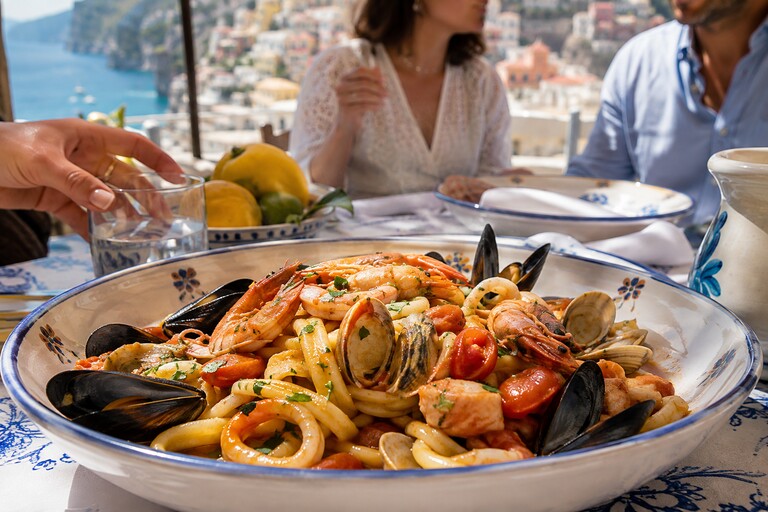
Order scialatielli ai frutti di mare, thick local pasta with shellfish; ndunderi in Minori, dumpling-like pasta with ancient roots; totani e patate, squid and potatoes; fried anchovies; and fish sold by weight. In Tramonti, look for pizza traditions and local wines. In Minori, try delizia al limone, a soft dome of sponge and lemon cream. The first forkful should smell like zest, not cleaning fluid.
Restaurant covers called coperto are normal when stated on the menu. Fish may be priced per 100 grams, so ask for the approximate whole-fish cost before approving it. A waterfront table is a product; decide consciously whether you want to buy it.
For value, eat your main restaurant meal at lunch, choose one course plus a side, and use bakeries or alimentari for picnics. Do not picnic on church steps or block residential stairs. Tap water is generally safe, though many restaurants default to bottled water.
A Five-Day Amalfi Coast Itinerary That Leaves Room to Breathe
Day One: Arrive and learn your base
Travel to Amalfi, check in, and resist immediate conquest. Explore Piazza Duomo, the cathedral complex, and the upper lanes. Walk to Atrani before dinner. Early sleep is not defeat; it is strategy.
Day Two: Ravello above the sea
Take an early bus or taxi to Ravello. Visit Villa Rufolo at opening, continue to Villa Cimbrone, and have lunch away from the busiest square. Return to Amalfi by bus or walk down toward Atrani only if conditions, footwear, and your knees agree.
Day Three: Positano from the water
Take the first useful ferry to Positano. Walk the upper road before descending to Spiaggia Grande and Fornillo. Book lunch or assemble a picnic. Return by ferry; if your chosen last sailing is critical, identify an earlier backup.
Day Four: Choose your adventure
Hikers should travel early to Bomerano for the Path of the Gods, finishing in Nocelle and descending toward Positano. Non-hikers can take a small-group boat tour with swimming stops. Do not combine the full hike and a boozy cruise unless you enjoy becoming a cautionary tale.
Day Five: The eastern villages
Travel by ferry or bus to Minori, walk part or all of the Path of Lemons, and continue to Maiori. Alternatively, visit Cetara for lunch and the harbor. Return early enough to pack, eat one last lemon dessert, and confirm tomorrow’s transfer.
With seven days, add a weather-buffer day, one beach day, and either Capri or Pompeii. With three days, keep days one through three and save the hike for another visit.
Amalfi Coast Trip Costs and Daily Budgets
Prices below are realistic planning ranges for 2026, not promises. July, August, weekends, sea views, and last-minute bookings push costs upward. City tax is usually charged separately by your accommodation and varies by municipality, property class, season, age, and number of nights.
Typical prices for essentials
- Espresso at the bar: €1.20–€2.50; table service in a prime square costs more.
- Cappuccino and pastry: €4–€8.
- Panino, pizza slice, or bakery lunch: €6–€12.
- Casual pasta or pizza dinner: €15–€28 per main dish.
- Seafood dinner with wine: €40–€80+ per person.
- Aperitivo: €8–€18.
- Gelato or granita: €3–€6.
- Local bus ride: commonly €2–€5, depending on distance and ticket.
- 24-hour SITA coast pass: about €10, or €12 with specified local-bus coverage.
- Ferry ride: often €5–€15 for short coastal routes; longer journeys cost more.
- Beach club: roughly €25–€80+, with premium rows and towns charging more.
- Villa Rufolo: €8 adult admission in 2026.
- Villa Cimbrone Gardens: €10 adult admission in 2026.
Budget traveler: €100–€170 per person per day
This assumes a shared room in Salerno, Maiori, Minori, or Agerola, bakery breakfasts, public transport, free hikes, public beaches, and one casual restaurant meal. Solo travelers pay more because accommodation does not divide politely.
Midrange traveler: €220–€380 per person per day
This covers a well-reviewed double room shared by two, restaurant meals, ferries, paid attractions, occasional beach-club use, and one group tour across the trip. Staying in Amalfi rather than central Positano keeps this category realistic.
Luxury traveler: €500–€1,200+ per person per day
Sea-view hotels, private transfers, charter boats, premium beach clubs, tasting menus, and suites can move the ceiling quickly. Luxury here converts best when it solves logistics: direct baggage handling, a good pier shuttle, reserved parking, or a terrace you genuinely use.
Money strategy: Carry a backup card and some euros for small shops, ticket sellers, and outages. Choose to pay in euros when a terminal offers home-currency conversion; the merchant’s conversion rate is often poor. Use a travel account that shows fees clearly and supports instant card controls.
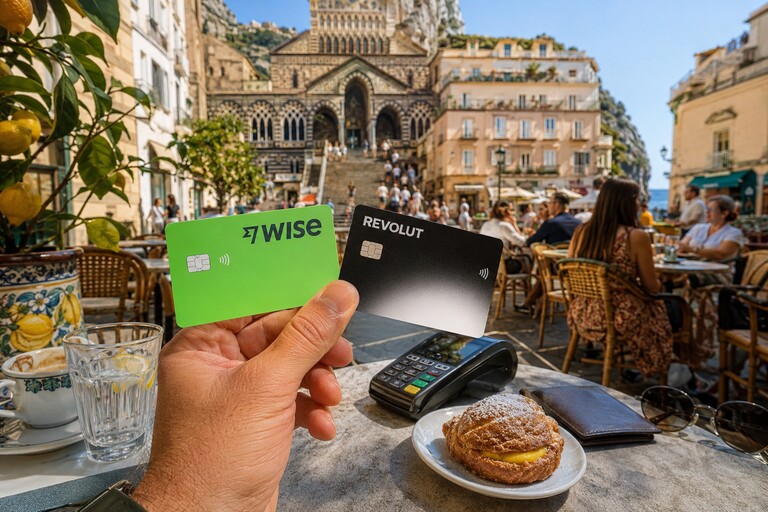
GET REVOLUT FOR TRAVEL SPENDING →
OPEN A WISE ACCOUNT FOR TRANSPARENT CURRENCY CONVERSION →
Practical Advice People Usually Learn One Staircase Too Late
Pack for terrain, not photographs
Bring grippy walking shoes, light layers, sun protection, a refillable bottle, water shoes, and a compact rain shell. Use a suitcase you can lift. Large hard-shell cases and ancient staircases have incompatible values.
Reserve, then reconfirm
Reconfirm transfers, boat tours, and special meals 24–48 hours ahead. Save addresses in Italian, booking numbers, and provider phone contacts offline. On a boat day, watch for weather messages before leaving breakfast.
Protect your valuables without becoming paranoid
Pickpocketing risk rises in crowded stations, ferries, buses, and queues. Zip your bag, keep your phone away from open doors, and separate backup cards. Do not leave luggage unattended on a beach or visible in a vehicle.
Accessibility requires direct questions
The coast’s slopes, stairs, pebble beaches, small boats, and older buildings create real barriers. “Accessible” can mean a lift exists after twelve entrance steps. Ask properties for the exact step count from street to room, elevator dimensions, shower setup, and distance over level ground. EAV publishes station accessibility information, and private transfers may be far easier than rail-bus combinations.
Travelers with limited mobility may prefer Maiori, central Amalfi, or Salerno over hillside Positano. Request assistance directly from transport operators in advance.
Entry rules are changing
Passport and visa requirements depend on nationality. The European Union’s Entry/Exit System (EES) became fully operational in April 2026, while ETIAS is scheduled for the last quarter of 2026 but did not yet have a precise launch date when this guide was updated. Use the official EU Travel to Europe website, not a paid lookalike application site.
Sustainable Travel That Helps More Than a Bamboo Toothbrush
The coast’s main visitor pressures include traffic, waste, water demand, path erosion, and the conversion of housing toward short-term use. Individual travelers cannot solve all of that, but your choices still land somewhere.
- Stay several nights instead of racing through on a coach. Overnight spending reaches bakeries, restaurants, laundries, and shops.
- Use ferries and buses rather than driving the SS163 for every outing.
- Choose smaller towns such as Minori, Maiori, Cetara, or Tramonti, and visit famous centers outside midday peaks.
- Refill water bottles where permitted and refuse unnecessary single-use items.
- Respect terrace agriculture. Do not pick fruit, enter private groves, or step on irrigation channels for a photograph.
- Stay on marked trails and carry every scrap out. Citrus peel is biodegradable, but it is still litter and can attract animals.
- Buy local products thoughtfully: ceramics from Vietri sul Mare, paper from Amalfi, wine from Tramonti, anchovy products from Cetara, and food from identifiable producers.
- Keep noise low in residential lanes, dress respectfully inside churches, and never fly a drone without checking national, local, and property rules.
- Save water and energy. Reuse towels, take reasonable showers, and switch off air-conditioning when doors are open.
The simplest rule is also the best: behave as if people must live here on Monday morning. Because they do.
Frequently Asked Questions About the Amalfi Coast
Is the Amalfi Coast expensive?
Yes, but not uniformly. Central Positano is costly; Maiori, Minori, Agerola, and Salerno offer better value. Public buses, hikes, churches, and public beaches help control spending. Accommodation and private transport create the largest differences.
Can I visit without a car?
Absolutely. In season, combine ferries and buses. Amalfi is the strongest car-free base. A private transfer on arrival or departure can remove luggage stress without requiring a vehicle for the full trip.
Is Positano or Amalfi better?
Choose Positano for romance, fashion, and the iconic vertical setting. Choose Amalfi for history, easier transportation, broader dining choices, and day trips. If you can, stay in Amalfi and visit Positano by early ferry.
Can you do the Amalfi Coast on a day trip from Rome?
Technically, yes. Enjoyably, rarely. The long transport chain leaves little time and magnifies delays. Stay at least one night in Naples, Salerno, Sorrento, or on the coast.
Do I need to book ferries in advance?
Book limited or high-priority routes in peak season, particularly island trips and journeys tied to check-in. For ordinary coastal hops, some flexibility helps when weather changes. Always inspect cancellation terms.
Is the Path of the Gods difficult?
It is a moderate hike with rocky ground, exposed sections, sun, and steep onward stairs. Regular walkers with suitable footwear generally manage the Bomerano-to-Nocelle section, but people with vertigo, mobility limitations, or heat sensitivity should assess it carefully or hire a guide.
Is the Amalfi Coast good for solo travelers?
Yes. Public transport makes a car unnecessary, towns are lively, and group tours simplify social contact. Solo accommodation costs are the main drawback. Stay near transport, avoid isolated paths after dark, and send someone your hiking plan.
Is it suitable for children?
Maiori is the easiest base for many families because of its waterfront and beach. Bring a compact folding stroller, but expect to carry it. Boat rides, heat, and stairs require planning; accommodations with elevators and pools should be verified, not assumed.
The Part Where the Coast Finally Slows Down
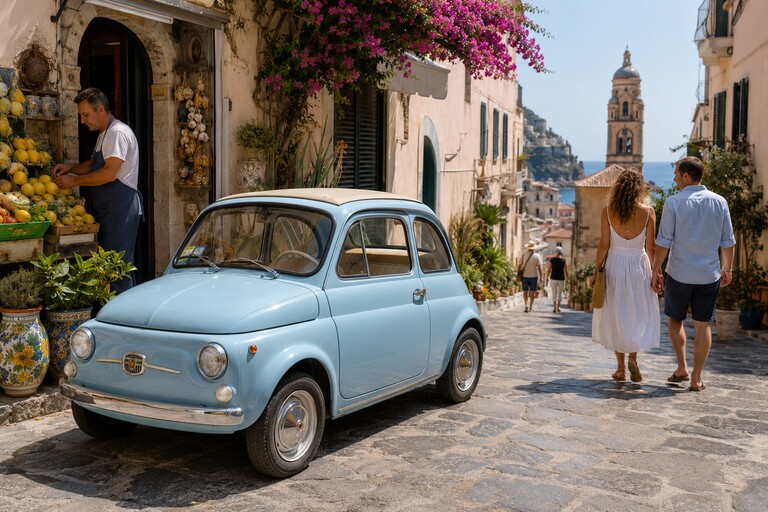
The best Amalfi Coast itinerary is not the one that collects the most towns. It is the one that gives the place time to become more than a backdrop. You need enough margin to miss a ferry without losing the day, enough appetite to order the anchovies, and enough humility to accept that a staircase marked “ten minutes” may have been timed by a mountain goat.
Come for Positano’s improbable geometry, but stay for quieter details: paper drying in an Amalfi workshop, a fishing boat returning to Cetara, bells carrying down from Ravello, lemon leaves rubbing together above Minori, and the sudden evening silence after the last day-trip boat pulls away. Those moments do not appear when every hour has been optimized.
Plan the expensive pieces early. Choose your base according to your legs and transport needs. Use the sea whenever conditions allow. Keep one day flexible. Spend money with local businesses that preserve the food, craft, farms, and paths you came to see. And when the bus is full, do what that woman outside Amalfi taught me: shrug, find the next route, and finish the granita.
If this guide saved you from one bad connection, one punishing suitcase climb, or one wildly overpriced plate of anonymous seafood, subscribe to A Tiny Traveler. I share honest itineraries, practical budgets, transport advice, hotel strategy, and the small mistakes that make travel stories worth telling.
Follow A Tiny Traveler on Pinterest as well, where I publish new destination guides, trip-planning ideas, packing advice, and visual itineraries you can save for later. Your next useful pin may be the one you open on a ferry pier while your original plan sails away without you.
Frank


