

Plan the ultimate Thailand train trip with this practical 2026 guide to sleeper trains, ticket booking, railway routes, fares, stations, daily budgets, packing, safety, and a flexible three-week itinerary.
The first warning came folded into a white railway blanket. On my first overnight run north, I had packed for tropical Thailand, meaning I had prepared for every climate except the one inside a Thai air-conditioned sleeper. By 2:00 a.m., the carriage felt cold enough to store fish. An attendant saw me wearing two shirts and a towel like a defeated Roman senator, produced another blanket, and smiled like a man who watches foreigners make this mistake nightly.
That journey taught me something useful: traveling Thailand by train is easy, but it rewards people who understand its odd little systems. The trains are not bullet trains. They rattle, wait outside stations for reasons nobody explains, and occasionally arrive at breakfast when the timetable had suggested dawn. Yet they also carry you past flooded rice fields, temple roofs, limestone ridges, rubber plantations, and back gardens that no airport transfer will ever show you.
This guide explains how to plan a complete Thailand train trip, from choosing a berth to connecting with ferries and border trains. It includes a realistic three-week route, 2026 sample fares, daily budgets, safety, sustainability, and details that separate a rail adventure from fourteen hours of wondering why you packed only shorts.
Follow the entire itinerary or steal the sections that suit you. Solo budget travelers, couples, families, and comfort-seeking visitors use the same railway; they simply need different seats and expectations. The rails do not reach every beach, but they form a wonderfully crooked backbone through the country.
The Short Answer: Is Train Travel in Thailand Worth It?

Yes—especially for overnight journeys, short historic-city hops, and travelers who enjoy the journey itself. A Thailand sleeper train combines transportation with a night’s accommodation, avoids an airport commute, permits normal-sized luggage without airline theater, and delivers you near a city center. A second-class lower berth is my usual sweet spot: broad enough for a decent sleep, private once the curtain closes, and social before bedtime.
Rail is not best for everything. Phuket, Krabi, Khao Sok, Chiang Rai, and the islands lack stations. Travel to the nearest gateway—usually Surat Thani, Chumphon, or Chiang Mai—then continue by road or ferry. Trains run late, so a tight train-to-flight connection is a gamble wearing a backpack.
Choose rail when you want an overnight bed or to see ordinary Thailand. Fly when time is short; take a bus where tracks do not go. There is no prize for spending sixteen hours on the wrong vehicle.
My quick class recommendation
- Under three hours: Choose third class or a reserved second-class seat.
- Three to eight hours: Choose second-class air-conditioned seating, unless you favor open windows.
- Overnight: Book a second-class air-conditioned lower berth.
- Couples wanting privacy: Book both berths in a first-class two-berth cabin.
- Light sleepers: Choose a newer CNR sleeper, bring earplugs, and still expect railway noises. Physics remains undefeated.
First, Understand the Railway Without Requiring an Engineering Degree
The State Railway of Thailand, or SRT, operates four main corridors from Bangkok. Think of a hand with fingers, not a tidy European web.

The Northern Line
The Northern Line runs through Ayutthaya, Lopburi, Phitsanulok, Lampang, and Lamphun to Chiang Mai. This is the classic first-time route and the country’s most requested sleeper journey. Phitsanulok is the rail gateway for Sukhothai, which requires a bus or car for the final leg.
The Northeastern Lines
Two branches serve Isan. One reaches Nakhon Ratchasima, Buriram, Surin, and Ubon Ratchathani. Another reaches Khon Kaen, Udon Thani, and Nong Khai, with trains crossing the Thai–Lao Friendship Bridge to Vientiane (Khamsavath). Fewer foreign visitors come here, and grilled chicken beside an evening station beats the queue for another viewpoint.
The Southern Line
The Southern Line serves Hua Hin, Prachuap Khiri Khan, Chumphon, Surat Thani, Hat Yai, and branches toward Trang, Nakhon Si Thammarat, Sungai Kolok, and Padang Besar in Malaysia. Use Chumphon for Koh Tao and Surat Thani for Koh Samui, Koh Phangan, Khao Sok, Phuket, and Krabi connections.
The Eastern and Western Curiosities
The Eastern Line reaches Pattaya, Aranyaprathet, and Ban Klong Luk near Cambodia. No passenger train crosses the border; continue by road.
From Thonburi Station, western trains run to Kanchanaburi and Nam Tok over the historic Death Railway. The peculiar Maeklong Railway Market trip uses two disconnected local lines and a ferry. It is a day adventure, not a cross-country link.
When to Take a Thailand Train Trip
November through February brings lower humidity and cool northern mornings, but it is peak season. Sleepers around Christmas, New Year, Lunar New Year, and Thai holidays sell quickly.
March through May brings serious heat. Fan carriages become rolling saunas, and temple days need more water. April’s Songkran festival fills trains; protect your only dry clothes.
June through October is rainy across much of the country, though regions differ. Rooms may cost less, and trains are quieter, but flooding can disrupt tracks. Check the Thai Meteorological Department and SRT live timetable before traveling.
The Gulf and Andaman coasts have different monsoon patterns. Check the exact coast; weather ignores blog schedules.
My Tip: Build one flexible night into the trip before any international flight. A train arriving two hours late is a story. A missed long-haul flight is a financial event.
How to Book Train Tickets in Thailand
Book officially through SRT D-Ticket. Foreign cards occasionally sulk. Enter names exactly as shown in passports; tickets are passenger-specific, and SRT does not permit name changes.
Eligible long-distance services can open 180 days ahead. The window depends on the train and distance traveled; short segments open later, while many local tickets sell at stations. “Unavailable” months ahead can mean “not on sale yet.”
Lower berths and cabins sell first. For Chiang Mai, Nong Khai, or Hat Yai in peak season, book when eligible. For an ordinary Ayutthaya train, buy at the station.
Official terms say online passengers should carry a printed ticket; I also save the PDF offline. Bring the booking passport.
Trip.com can compare trains, buses, and connections. Before paying, check the operator, station, class, conditions, service fee, and total.
Reading the train names
Special Express is generally fastest. Express and Rapid services make more stops and mix classes. Ordinary, local, and commuter trains are slow, cheap, and useful for short rides.
Check the carriage type. Special Express No. 9 to Chiang Mai uses modern CNR sleepers; other departures use older stock. Older can mean wider berths, opening windows, and fewer outlets.
Changes, cancellations, and missed trains
Refund and change fees depend on timing and ticket type. Current D-Ticket terms allow eligible online refunds at least three hours before departure, with deductions; tourist tickets may be nonrefundable. Read your fare conditions.
If you miss a train, ask the ticket office; do not assume validity on the next service. Confirm schedules through SRT or 1690.
Bangkok Has Several Stations, Because One Would Be Too Easy

Most long-distance expresses depart from Krung Thep Aphiwat Central Terminal (KTW) beside Bang Sue. Reach it through the MRT Blue Line at Bang Sue Station. Arrive 45–60 minutes early; its scale makes adults feel like misplaced carry-ons.
Hua Lamphong handles selected local and eastern services, including Aranyaprathet and some Ayutthaya trains, and still sells tickets.
Kanchanaburi and Nam Tok trains use Thonburi Station. The Maeklong trip starts at Wongwian Yai, then resumes at Ban Laem after a ferry. Read your ticket: “Bangkok” is a city, not a platform.
If you land late or carry bulky luggage, prearrange an airport ride. Learn Bangkok traffic philosophy tomorrow.
First, Second, or Third Class: What Your Money Actually Buys
First-class sleeper
A first-class sleeper has a lockable two-berth cabin, air-conditioning, washbasin, bedding, and shared toilets. Newer cars may have a shower. A ticket buys one berth; solo travelers may share with a passenger of the same gender unless buying single occupancy.
Choose it for privacy or connecting family cabins. Supply is tiny and sells early.
Second-class sleeper
In the evening, facing seats become a lower berth, while an upper berth folds down. Staff adds sheets, pillow, blanket, and curtains. The carriage stays open-plan, but the curtain gives privacy.
The lower berth is wider, easier to enter, and often has a window. The upper is narrower, darker, colder, and cheaper. I usually pay for the lower.
Second-class seat
A reclining second-class air-conditioned seat suits daytime routes such as Hua Hin or Phitsanulok–Chiang Mai. Keep a light layer accessible.
Third class
Third class means fans, open windows, simple seats, vendors, heat, and dust. It is excellent for Ayutthaya or Kanchanaburi, but poor for sleeping.
Selected modern trains have accessible spaces and women-and-children cars. Older platforms and toilets can be difficult; contact SRT if assistance is essential.
The Complete 3-Week Thailand Train Itinerary
This 21-day Thailand train itinerary follows a practical north-to-south spine with a western detour. It favors meaningful stops over collecting station signs. Add the Isan or Laos extension later if you have another four to seven days.
Days 1–3: Bangkok, where the rails begin
Spend three nights in Bangkok. Visit Wat Pho early, cross the Chao Phraya River to Wat Arun, eat along Yaowarat Road, and ride a public river boat when traffic resembles poured concrete.
Use one morning for Talat Noi and Hua Lamphong. Buy water, fruit, nuts, something savory, and breakfast insurance. Catering changes, and delays happen precisely when you are hungry.
Stay near the MRT, BTS, or river boats; a cheap outer hotel stops feeling clever after four taxis.
FIND WELL-LOCATED BANGKOK HOTELS ON BOOKING.COM
COMPARE BANGKOK FOOD TOURS, TEMPLE TOURS, AND DAY TRIPS ON GETYOURGUIDE
Day 4: Bangkok to Ayutthaya

Take a morning train to Ayutthaya, roughly 1–2 hours depending on service. Cheap third-class ordinary fares can be around 20 baht, while faster reserved and air-conditioned services cost more. Check both Hua Lamphong and Krung Thep Aphiwat departures.
The historical park lies across the river. Cross by ferry, then cycle if comfortable in heat and traffic; otherwise agree on a tuk-tuk route and price. Prioritize Wat Mahathat, Wat Ratchaburana, and Wat Chaiwatthanaram. Temple brick holds heat like an old grudge.
Stay overnight for quieter ruins. Try boat noodles: dark broth, herbs, meat, and chili moving from fragrant to confrontational in one spoonful.
Days 5–6: Ayutthaya to Phitsanulok and Sukhothai

Continue to Phitsanulok by daytime train, commonly 4–6 hours. Watch concrete thin into rice fields, small stations, sleeping dogs, and swift platform trade.
Visit Phitsanulok’s Wat Yai, then eat noodles near the Nan River. Continue by road to Sukhothai Historical Park; there is no Sukhothai station. Stay near the old city, about 12 kilometers from modern town.
At Sukhothai, cycle when gates open. Flat paths pass ponds, columns, seated Buddhas, and precious shade. A small car helps with outer zones.
My Tip: Never rent a scooter merely because somebody at a hostel called it easy. Use only vehicles your license, insurance, and experience actually cover. Hospital paperwork is a poor souvenir.
Days 7–10: The daylight climb to Chiang Mai

Return to Phitsanulok and take a daytime train to Chiang Mai. The final section through Lampang, Khun Tan, hills, and tunnels deserves daylight. For sleepers, No. 9 is modern; No. 13 often reaches the mountains after sunrise.
Recent sample station fares for Bangkok–Chiang Mai place a second-class air-conditioned berth at roughly 748–1,038 baht, depending on train and upper or lower position. First-class berths can run roughly 1,246–1,646 baht, with a higher single-occupancy price. Verify your exact date on D-Ticket.
Give Chiang Mai three full days. Visit Wat Chedi Luang at opening, evening stalls at Chang Phuak Gate, and Warorot Market for breakfast. Avoid competitive shrine accumulation.
Reserve a day for Doi Suthep, cooking, or nature. Avoid elephant riding, forced bathing, tricks, and close-contact photographs; welfare respects an animal’s ability to walk away.
Order khao soi: soft noodles below, fried noodles cracking above, coconut curry on the lips, pickled greens cutting richness, and chili oil arriving late. Serious bowl engineering.
BROWSE CHIANG MAI COOKING CLASSES AND RESPONSIBLE DAY TOURS ON GETYOURGUIDE
Day 11: Chiang Mai to Bangkok by sleeper
Now take the overnight train you avoided earlier. Buy dinner before boarding, arrive about 45 minutes early, and keep your ticket and passport accessible. Stow a large bag beneath the lower berth or in the designated area, then keep valuables, medication, and electronics inside a small daypack at your pillow.
The attendant usually converts seats into beds during the evening. Do not climb into an unmade berth and begin arranging a private kingdom; wait for the bedding ritual. Close the curtain, use earplugs, keep shoes positioned for a midnight toilet expedition, and set a gentle alarm before arrival. Staff normally wake passengers, but outsourcing every responsibility to a stranger is how travel comedies begin.
Days 12–14: Kanchanaburi and Nam Tok
From Thonburi Station, take the local train to Kanchanaburi. Foreign tourist fares on this route have commonly been 100 baht per segment. Buy at the station and bring cash. Sit on the left leaving Kanchanaburi toward Nam Tok for strong views along the Wang Po Viaduct, although carriage direction can complicate perfect advice.

The landscape is easy to admire; the history is not. Visit the Thailand–Burma Railway Centre, Kanchanaburi War Cemetery, and bridge. Forced laborers, prisoners, and civilians died building the line; use Death Railway with that reality attached.
Ride toward Nam Tok and transfer by road to Hellfire Pass. Carry water, cover shoulders, and leave the speaker at the hotel. Some places ask for quiet without posting a sign.
Day 15: Back through Bangkok
Return to Bangkok and sleep there before turning south. This buffer absorbs delays, gives you laundry time, and prevents the itinerary from feeling like a prison sentence written by a railway enthusiast. Stay near your next departure line and eat something fresh rather than another platform snack.
Days 16–17: Bangkok to Hua Hin
Travel south to Hua Hin, usually around 3–5 hours depending on the train. Fares vary widely by service, from inexpensive ordinary seats to reserved air-conditioned options. The restored Hua Hin Railway Station, beach, night market, and seafood make an easy two-night pause.
Hua Hin is a working resort city, not an empty fantasy. Walk beyond central beach entrances and eat where fish is displayed on ice, not represented by laminated sunsets.
Days 18–19: Chumphon, Surat Thani, or an island connection

Choose your southern gateway according to the coast you actually want.
- Use Chumphon for Koh Tao. Recent sample fares put a Bangkok–Chumphon second-class air-conditioned sleeper around 649–919 baht at the station, depending on train and berth. Combined ferry transfers cost extra.
- Use Surat Thani Railway Station, located in Phun Phin outside Surat Thani City, for Koh Samui, Koh Phangan, Khao Sok, Phuket, or Krabi. A recent sample fare for a second-class air-conditioned sleeper from Bangkok is around 804 baht; first class starts higher.
- Continue toward Trang for quieter Andaman access, or Hat Yai for southern food and the Malaysian border.
Never book a ferry twenty minutes after a train. Allow at least three hours, more before the final boat. Check whether combined tickets guarantee connections.
Give any island three nights. A one-night stop is mostly piers and bag handling.
Days 20–21: Hat Yai and Padang Besar
Finish in Hat Yai, where Thai, Chinese, and Malay influences meet. Eat dim sum, peppery bak kut teh, and fried chicken with a thin crust over shallot-scented rice. Visit Kim Yong Market, a real trading place, not a camera set.
Modern Special Express No. 31, the Thaksinarath, runs between Bangkok and Hat Yai. Current listed fares are about 1,005 baht for an upper second-class berth and 1,105 baht for a lower; first-class berths are roughly 1,594–1,794 baht. Prices and consist can change.
For Malaysia, Special Express No. 45 continues from Bangkok to Padang Besar, with immigration handled at the border station. Remember that Malaysia is one hour ahead of Thailand. Book the onward Malaysian train separately through the official KTM Berhad ticket system, and leave a generous connection buffer. From Padang Besar, trains run toward Butterworth for Penang and toward Kuala Lumpur.
Entry rules are separate from rail tickets. Check passport validity, visa requirements, and arrival forms for your nationality before reaching the platform. A conductor cannot negotiate with immigration on behalf of your optimistic itinerary.
The Isan and Laos Extension: Four to Seven Extra Days
Add a northeastern branch after Bangkok. Take a sleeper to Nong Khai, or direct Rapid No. 133 to Vientiane (Khamsavath). Published times are about 9:25 p.m. departure, 7:55 a.m. at Nong Khai, and 9:05 a.m. arrival. Reconfirm.
Recently listed Bangkok–Vientiane fares are approximately 281 baht in third class, 574 baht for an air-conditioned second-class seat, 784 baht for an upper sleeper, and 874 baht for a lower sleeper. The train is practical rather than plush. For newer equipment, ride Special Express No. 25 to Nong Khai, then connect across the border.
Passengers disembark with luggage for immigration. Khamsavath Station is outside central Vientiane. For Vang Vieng or Luang Prabang, transfer stations and book the Laos–China Railway separately.
In Thailand, stop for food in Udon Thani or the Mekong riverfront in Nong Khai. Another branch links Nakhon Ratchasima, Buriram, Surin, and Ubon Ratchathani.
What a Thailand Train Trip Costs in 2026
At the time of checking, US$1 is roughly 33 Thai baht, but exchange rates move. I budget in baht, then use the live rate inside Wise or Revolut before withdrawing or paying.
Realistic daily budgets per person
Budget traveler: 1,200–2,000 baht (about US$36–61)
- Hostel dorm or simple room: 350–800 baht
- Street food and local meals: 250–500 baht
- Local transport: 100–250 baht
- Attractions and miscellaneous costs: 200–450 baht
- Average rail allocation: 200–400 baht daily, spread across the trip
Comfortable midrange traveler: 2,800–5,000 baht (about US$85–152)
- Private hotel room: 1,200–2,800 baht
- Food and coffee: 600–1,200 baht
- Local transport: 250–600 baht
- Activities: 400–1,000 baht
- Rail allocation: 300–600 baht daily
Comfort-focused traveler: 6,000–12,000+ baht (about US$182–364+)
This covers higher-end hotels, transfers, first-class cabins, and guided experiences. Islands and holidays cost more.
Prices of everyday essentials
- Local rice or noodle dish: 50–120 baht, often more in tourist centers and islands
- Coffee: 50–120 baht
- Bottled water: 10–25 baht; refill where safe to reduce plastic
- Laundry by weight: roughly 40–80 baht per kilogram
- Local city bus or songthaew ride: commonly 15–60 baht
- Short metered taxi ride: often 80–200 baht, traffic dependent
- Foreign-card ATM fee: commonly around 220 baht per withdrawal, plus any home-bank fee
Carry cash for ticket windows, vendors, and transfers. At ATMs, choose a Thai baht charge rather than poor automatic currency conversion.

GET WISE FOR THAI BAHT SPENDING AND LOWER-FRICTION CURRENCY CONVERSION
TRY REVOLUT FOR TRAVEL SPENDING, EXCHANGE, AND BACKUP CARD ACCESS
My Tip: Carry two cards stored separately. A swallowed card becomes an inconvenience rather than a full financial biography.
Sleeper-Train Survival Without Becoming That Passenger
Pack a small overnight pouch so you do not excavate your suitcase after lights-out. Mine contains:
- Passport, printed ticket, wallet, and phone
- Earplugs and an eye mask
- A light sweater, socks, and long pants for enthusiastic air-conditioning
- Toilet paper, hand sanitizer, and wet wipes
- Toothbrush and a tiny toothpaste
- Power bank and charging cable
- Refillable water bottle and quiet snacks
- Medication, including motion-sickness treatment if needed
- Flip-flops or easy shoes for the toilet
Store large luggage beneath seats or in carriage racks. Label it, secure zippers, never block aisles, and keep valuables with you.
Toilets can be western or squat and become philosophical by morning. Follow instructions and wear shoes. This is not the moment for barefoot authenticity.
Some trains have restaurant cars or vendors, but catering changes. Bring food if dietary restrictions matter. Avoid loud packaging and calls after curtains close.
Alcohol sale and consumption are prohibited on SRT trains and stations. Smoking is also prohibited in passenger areas. Treat the carriage as shared sleeping space: headphones on, lights low, calls brief, and alarms quiet.
Staying Connected Between Stations
Do not expect onboard Wi-Fi. Download tickets, maps, Thai hotel addresses, translation data, and entertainment before departure.
For an eSIM, compare data, tethering, and validity; install it on reliable Wi-Fi. Store its QR code on another device.
Safety, Insurance, and Border Paperwork
Thai trains are generally straightforward for solo travelers. Keep valuables in your berth, zip your daypack, verify staff, and share your train number and arrival time with somebody you trust.
For urgent tourist assistance, the Tourist Police hotline is 1155, available around the clock. General police are 191, medical emergencies 1669, and the SRT hotline is 1690. Save the numbers offline. The official Tourist Police website has current contact information.
Insurance should cover medical care, disruption, theft, and planned activities. Check scooter, trekking, diving, alcohol, and preexisting-condition exclusions.
All non-Thai nationals entering Thailand by air, land, or sea must complete the free Thailand Digital Arrival Card within the official window—currently up to 72 hours before arrival, including the arrival date. Use only the government site; lookalike services may charge unnecessary fees. A new submission is required for each entry, including returning from Laos or Malaysia.
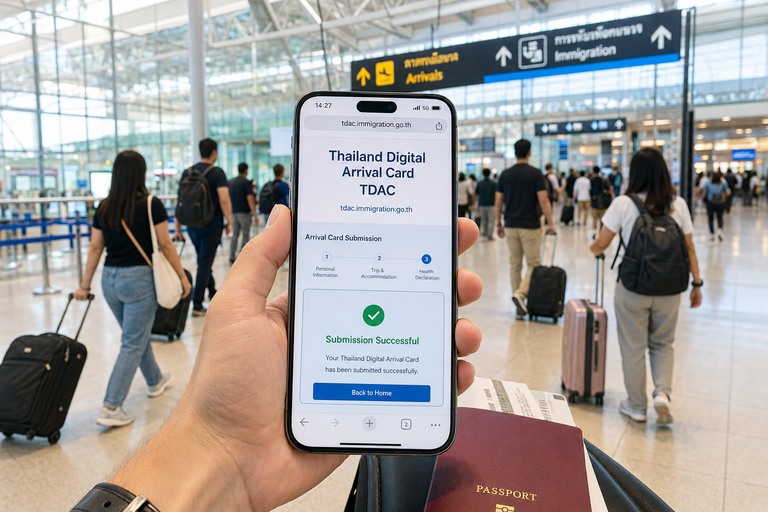
Visa rules depend on nationality. Check the Thai embassy and neighboring-country requirements, passport validity, and blank-page rules.
Sustainable Train Travel That Goes Beyond Reusing a Towel
Rail can reduce reliance on domestic flights, but sustainability also depends on behavior after the station.
- Stay longer in fewer places. Three nights create less transport churn than hurried day stops.
- Carry a refillable bottle and reusable utensils. Ask hotels for filtered-water refill points rather than buying a new bottle at every station.
- Eat at locally owned shops and markets. Learn a few Thai food words.
- Use public ferries, songthaews, walking, and bicycles when safe and practical.
- Choose animal experiences carefully. Avoid riding, performances, forced handling, and venues breeding wildlife for tourist contact.
- Dress respectfully at temples and memorials. Sustainability includes cultural behavior.
- Reduce laundry and air-conditioning use. Small actions repeat across weeks.
- Travel outside peak bottlenecks when possible. Your money reaches communities more steadily, and you spend less time standing behind other people taking the same photograph.
Favor operators explaining local employment, waste treatment, refill systems, wildlife standards, or certification. An “eco” leaf is design, not evidence.
Common Mistakes I Would Cheerfully Prevent
Booking the wrong Bangkok station
Check for KTW, Hua Lamphong, Thonburi, or Wongwian Yai. Leave early; Bangkok traffic mocks map estimates.
Choosing an upper berth without understanding it
Upper berths are cheaper, narrower, colder, and often windowless. Mobility concerns favor lower berths.
Scheduling a flight after a long-distance train
Stay a final night. Trains can also introduce you to a field outside Nakhon Pathom for forty-five minutes.
Assuming every famous place has a station
No direct train serves Phuket, Krabi, Khao Sok, Sukhothai, Pai, or Chiang Rai. Plan the road segment.
Trusting old schedules
Departure stations, train numbers, equipment, and times change. Recheck SRT D-Ticket, the live SRT timetable, or 1690 shortly before travel.
Packing for the country instead of the carriage
Outside: hot. Inside the air-conditioned sleeper: poultry-storage ambitions. Keep a warm layer in your daypack.
A Final Booking Checklist Before Every Rail Day
The evening before departure, open your ticket and verify the date, train number, station, carriage, berth, and departure time. Then check the live timetable for disruption. Screenshot both pages and send the itinerary to your travel companion or emergency contact. Ask the hotel how long the station journey takes during real traffic, not empty-road fantasy, and arrange transport with a generous margin.
Charge your phone and power bank. Put your printed ticket, passport, medication, glasses, earplugs, warm layer, and an amount of cash in the daypack that stays beside you. Download the destination hotel address in Thai. Buy water and food before reaching the platform, especially when traveling late or managing allergies.
Finally, confirm the first transfer after arrival. Know whether you need a ferry desk, bus counter, taxi stand, or hotel pickup, and know the backup if the train is delayed. Do not pay an unmarked driver merely because he confidently says your bus has left. Confidence is not a timetable. A five-minute check at reception can prevent a sweaty argument at dawn.
Frequently Asked Questions About Thailand Train Travel
How far ahead should I book a Thailand sleeper train?
Book when eligible for December–February, Songkran, and holidays. Some long-distance services open 180 days ahead; short and local journeys open later.
Is the Bangkok to Chiang Mai sleeper train safe?
Yes, with normal precautions: retain valuables, ticket, and passport, close your curtain, and do not leave electronics unattended.
Which is better, first class or second class?
Choose first class for privacy and second class for value and sociability. I recommend a lower second-class berth for most travelers.
Can I take a train directly to Phuket or Krabi?
No. Take a southern train to Surat Thani, then connect by bus or minivan. Allow several hours between independently booked services.
Are Thailand trains usually late?
Short delays are common, and longer delays happen. Never build a critical same-day flight or final ferry around an exact long-distance arrival time.
Can I buy food onboard?
Sometimes, but catering changes. Bring water and enough food for the journey.
Do Thai sleeper trains have showers?
Some newer first-class cars have showers. Second class generally does not. Bring wipes and lower morning standards with dignity.
Can I bring a bicycle?
Bicycles travel for a fee on many baggage-car trains, but not many CNR sleepers or railcars. Confirm with SRT.
Is there a Thailand rail pass?
Most visitors buy point-to-point tickets, which suit this itinerary.
Can children use sleeper trains?
Yes. Fares depend on age and height. Check rules and carry each child’s identification.
The Last Platform, and Why I Would Do It Again

A Thailand train trip will not run exactly as planned. Trains arrive late, lower berths disappear, and ferry waits grow. Build margins, and inconvenience becomes texture instead of crisis.
This route gives you old capitals, northern food, difficult history, beach gateways, southern markets, and actual beds. With less time, choose Bangkok–Ayutthaya–Chiang Mai or Bangkok–Hua Hin–Surat Thani. With more, add Isan, Laos, or Malaysia.
Book sleepers first, then flexible hotels. Keep a buffer before flying. Spend on a lower berth if sleep matters, use third class for short rides, and reject animal exploitation. Carry cash, two cards, a printed ticket, a warm layer, and patience.
Compare station-area rooms early. Choose tours that fit your stops, read insurance exclusions, and pay in local currency. Booking tools should remove friction, not create purchases you do not need.
If this guide made the railway bookable, subscribe to A Tiny Traveler for detailed routes, honest costs, practical mistakes, curious detours, and food worth missing a train for.
Follow A Tiny Traveler on Pinterest and save this post to your Thailand board for upcoming rail itineraries, city guides, budgets, packing advice, and route ideas. You will also find it when Krung Thep Aphiwat’s six escalators have erased your memory.
My last memory of that first sleeper is not the cold. It is opening the curtain before Chiang Mai and seeing pale morning collect over wet fields while somebody farther down the carriage poured instant coffee. The train rocked, metal knocked against metal, and the day arrived without ceremony. Slow, imperfect, and right on time in the only way that mattered.
Frank


